Monday, 1 January 2024

Major meteor showers for 2024.


Northern Hemisphere Meteor Showers

All images are from SkySafari 6 Pro 

January: Quadrantids


The Quadrantids occur in early January and are known for their brief but intense meteor shower. Originating from the debris of asteroid 2003 EH1, they peak around January 3-4 annually. Named after an obsolete constellation, Quadrans Muralis, these meteors appear to radiate from the northern sky. With up to 100 meteors per hour under optimal conditions, the Quadrantids are often overlooked due to their timing during cold winter nights.

April: Lyrids


The Lyrid meteor shower, active from April 16 to 25, peaks around April 22. Resulting from the debris trail of Comet C/1861 G1 Thatcher, this shower is one of the oldest recorded, dating back over 2,600 years. Originating from the constellation Lyra, these meteors are visible in the northern hemisphere. With a rate of 10 to 15 meteors per hour, the Lyrids sometimes produce bright fireballs.

August: Perseids


The Perseids, arguably the most popular meteor shower, peak around August 11-13. Created by the debris of Comet Swift-Tuttle, they are observed annually between July 17 and August 24. Named after the constellation Perseus, these meteors are best viewed after midnight and can produce up to 100 meteors per hour. Their reliable and bright display makes them a favorite among stargazers.

October: Orionids


Active from October 2 to November 7, the Orionids peak around October 21-22. Originating from Halley's Comet, these meteors radiate from the constellation Orion. With a rate of around 20 meteors per hour, the Orionids are known for their speed and brightness. They are often visible even in areas with moderate light pollution.

November: Leonids


The Leonid meteor shower, originating from Comet 55P/Tempel-Tuttle, peaks around November 17-18. It's famous for periodic meteor storms, with the most notable occurring in 1833 and 1966. Although these storms are infrequent, producing thousands of meteors per hour, the typical Leonids display produces around 10 to 15 meteors per hour. They radiate from the constellation Leo.

Southern Hemisphere Meteor Showers

January: No Major Meteor Shower

April: Eta Aquariids


The Eta Aquariids, created by Halley's Comet, are visible from late April to mid-May, peaking around May 6. While more favorable to the northern hemisphere, southern observers can still witness around 10 to 20 meteors per hour. Originating from the constellation Aquarius, these meteors are known for their speed.

August: No Major Meteor Shower

October: Draconids (Minor Activity)


While more favorable for the northern hemisphere, the Draconids have minor activity visible in the southern hemisphere. Active from October 6-10, they peak around October 8. Originating from Comet 21P/Giacobini-Zinner, these meteors radiate from the constellation Draco.

November: Taurids


The Taurids, active from late October to late November, peak around November 5-12. These meteors, from Comet 2P/Encke, appear to radiate from the constellation Taurus. While not producing a high rate of meteors (around 5 per hour), they are known for producing bright fireballs.

Each meteor shower offers stargazers a unique celestial spectacle, encouraging enthusiasts to mark their calendars and find optimal viewing locations to witness these cosmic displays.

Sunday, 9 April 2023

The Lyrids meteor shower 2023

The Lyrids meteor shower is an annual celestial event that occurs in mid-to-late April, typically peaking around April 21st. This meteor shower is caused by debris from the comet Thatcher, which enters the Earth's atmosphere and burns up, creating a stunning display of shooting stars.

 The Lyrids meteor shower is one of the oldest known meteor showers, with records dating back over 2,600 years. It is named after the constellation Lyra, which is the location of the radiant point - the area of the sky from which the meteors appear to originate.

 This year, the Lyrids meteor shower is expected to be visible from April 16th to April 25th, with the peak occurring on the night of April 21st. The best time to observe the meteor shower is after midnight, when the radiant point is higher in the sky. Stargazers can expect to see an average of 10 to 20 meteors per hour during the peak of the Lyrids meteor shower, with some years having higher rates of activity. The Lyrids are known for producing bright fireballs, which are larger and brighter than the average meteor.

 To observe the Lyrids meteor shower, find a location away from light pollution with a clear view of the sky. Dress warmly and bring a comfortable chair or blanket to sit on. Look towards the northeastern part of the sky and use a star chart to locate the constellation Lyra and the radiant point. Overall, the Lyrids meteor shower is a beautiful display of nature's wonders and a must-see for any stargazing enthusiast.

 The image below is taken from Stellarium and shows the location of the radiant from a southern hemisphere perspective.

Thursday, 3 February 2022

We’ve found the first ever ‘shocked’ zircon crystal from Mars. It provides a new view on when conditions for life may have arisen

NASA
Aaron J. Cavosie, Curtin University and Morgan Cox, Curtin University

Are we alone in the Universe? Billions of dollars are being spent trying to answer that simple question. The implications of finding evidence for life beyond Earth are staggering. The “before and after” mark would punctuate human history.

Mars is currently the most popular exploration target to search for evidence of life elsewhere. Yet little is known about its early history. Our research on a Martian meteorite provides new clues about early surface conditions on the red planet.

Windows into the past

Today Mars is cold and inhospitable. But it may have been more Earth-like and habitable in a bygone era. Landforms on Mars record the action of liquid surface water, perhaps as early as 3.9 billion years ago.

Like Earth, early Mars was subject to a global bombardment from chunks of rock and ice floating around the Solar System. Giant impacts both destroy and create favourable environments for life. So to untangle when conditions suitable for life may have arisen on Mars, we have to track the history of both water and impacts.

A flotilla of rovers and orbiting spacecraft have been dispatched to Mars, with two NASA rovers specifically exploring impact craters for evidence of past life. Samples collected by rovers will be returned in future missions.

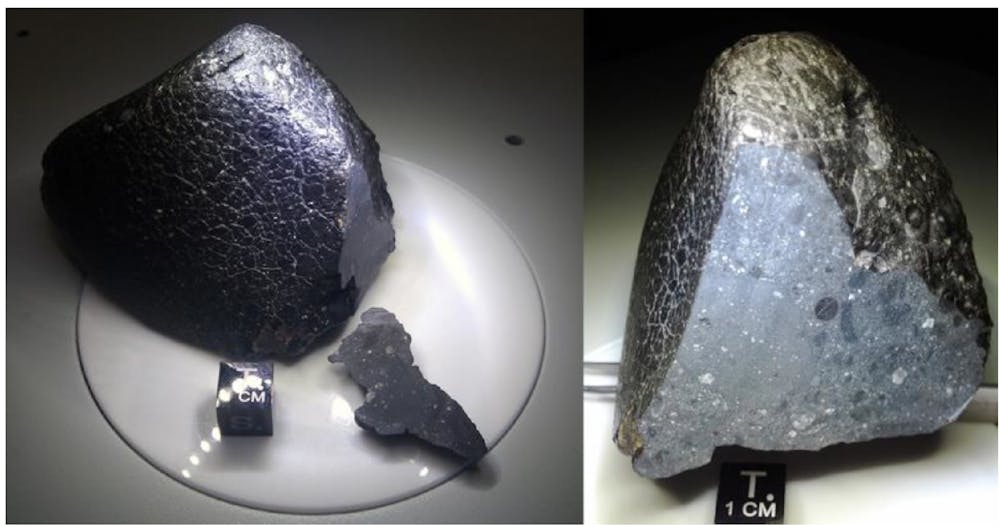
For now, meteorites are the only samples of Mars available to study here on Earth. Martian meteorites are born when an impact on Mars ejects rocky fragments that later intercept Earth’s orbit. Most Martian meteorites are igneous rocks, such as basalt. One meteorite, NWA 7034, is different, as it represents a rare sample of the surface of Mars.

Meteorite NWA 7034 has been dubbed ‘Black Beauty’. Carl Agee

Sending shock waves

The NWA 7034 meteorite, weighing about 320g, was found in the desert of northwest Africa and first reported in 2013. Unique oxygen isotope signatures reveal its origin from Mars. Other meteorites blasted off of Mars during the same event have since been found.

NWA 7034 is a complicated rock made of broken rock and mineral shards called “breccia”. Its various fragments record different snippets of Martian history.

In this element map of the martian meteorite NWA 7034 different colours correspond to different rock and mineral fragments. Author provided

Tiny grains of the mineral zircon occur in NWA 7034. Zircon is a “geochronometer”, meaning it records (and reveals to us) how much time has passed since it crystallised from magma. Prior studies of NWA 7034 found it contains the oldest known zircons from Mars – some up to 4.48 billion years old.

Zircon is quite useful for studying meteorite impacts. It preserves microscopic damage caused by the passage of shock waves, and these “shocked grains” provide a solid record of impact. However, no zircons with definitive shock damage had been identified in previous studies of NWA 7034.

NWA 7034 is similar to a type of sedimentary rock on Earth called conglomerate. In such rocks, every mineral can have a different origin. With that in mind, we set out to survey additional zircon grains in NWA 7034 to see if we could find any that recorded evidence of impact.

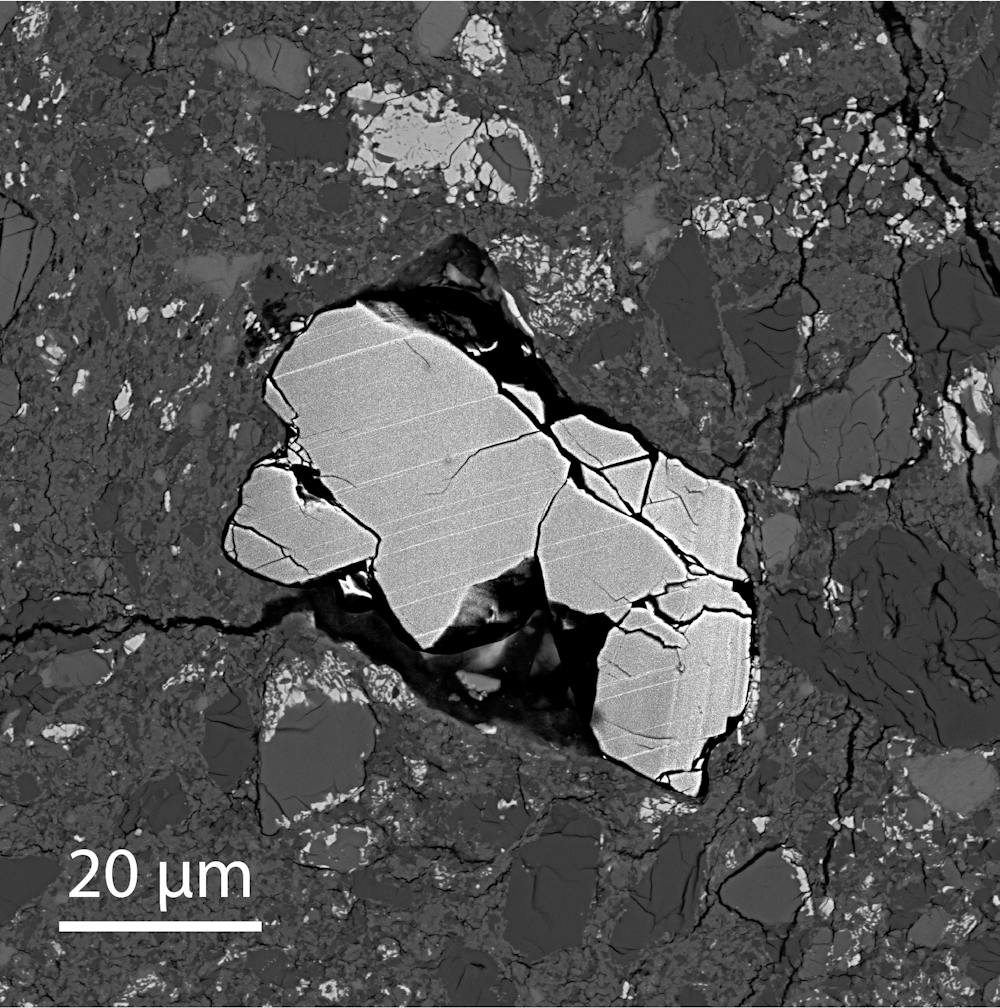
We looked at more than 60 zircons, but found only one shocked grain. This means the impact occurred before the grain was mixed into the pile of fragments that became a rock.

Reassessing Mars’s timelines

The type of shock features we found are called “deformation twins”. High pressure shock waves squeeze zircon like an accordion. This process can reorganise atoms within the crystal, to form a duplicated “twin” of zircon, which we can detect.

Scanning electron image of a shocked zircon in the matrix of martian meteorite NWA 7034. Author provided

We determined the zircon crystallised 4.45 billion years ago, making it one of the oldest zircons known from Mars – even older than the oldest known piece of Earth (also a zircon).

We don’t know what kind of rock the shocked zircon originally formed in. The original igneous host rock was ripped apart during impacts on Mars. The zircon is a broken fragment from a larger grain mixed in with the matrix of the meteorite.

We do, however, know where shocked zircons like this are made. On Earth, shocked zircons with deformation twins are only found at impact craters. Moreover, they occur at all of Earth’s largest asteroid strikes.

Zircons with shock features have been found at Vredefort in South Africa, Sudbury in Canada and Chicxulub in Mexico. The Mexican crater formed about 65 million years ago, and has been linked to the extinction of the dinosaurs. In this case, shocked zircons were one product of an impact large enough to cause a mass extinction.

Prior studies cited an absence of shock features in zircon from NWA 7034 to indicate a decline in catastrophic impacts on Mars by 4.48 billion years. It was further proposed that habitable conditions existed as of 4.2 billion years ago.

However, the shocked zircon we found crystallised 4.45 billion years ago. The shock event would have had to have occurred at least 30 million years after Mars had supposedly stopped being bombarded.

When exactly was the impact?

Although determining the precise age of impact is difficult, geochemical studies of NWA 7034 reveal its main components were subject to meteorite impacts before roughly 4.3 billion years ago. In this scenario, the zircon may have been shocked during this time, somewhere between 4.3 and 4.45 billion years ago.

Alternatively, it may have formed more recently, but before a decline in the rate of impacts earlier than 3 billion years ago. Both land forms and water-bearing minerals argue for early surface water on Mars, possibly by 3.9 to 3.7 billion years ago. This may be the best indicator for when habitable conditions existed.

Our findings raise new questions about the early impact history of Mars. Determining the origin of the shocked zircon, and time of impact, will provide better context for interpreting the planet’s history as archived in meteorite NWA 7034 – and potentially a timeframe for when conditions for life may have emerged.The Conversation

Aaron J. Cavosie, Senior research fellow, Curtin University and Morgan Cox, Geologist, Curtin University

This article is republished from The Conversation under a Creative Commons license. Read the original article.

Sunday, 25 April 2021

Warp drives: Physicists give chances of faster-than-light space travel a boost

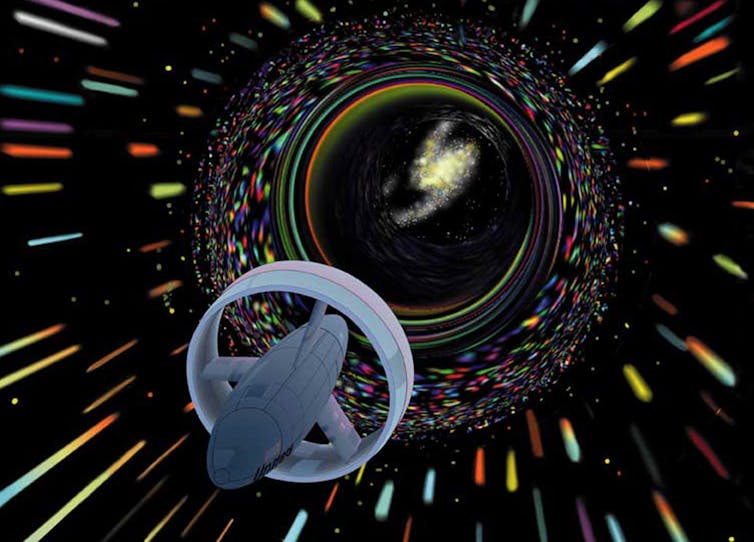
Faster than light travel is the only way humans could ever get to other stars in a reasonable amount of time. Les Bossinas/NASA/Wikimedia Commons
Mario Borunda, Oklahoma State University

The closest star to Earth is Proxima Centauri. It is about 4.25 light-years away, or about 25 trillion miles (40 trillion km). The fastest ever spacecraft, the now- in-space Parker Solar Probe will reach a top speed of 450,000 mph. It would take just 20 seconds to go from Los Angeles to New York City at that speed, but it would take the solar probe about 6,633 years to reach Earth’s nearest neighboring solar system.

If humanity ever wants to travel easily between stars, people will need to go faster than light. But so far, faster-than-light travel is possible only in science fiction.

In Issac Asimov’s Foundation series, humanity can travel from planet to planet, star to star or across the universe using jump drives. As a kid, I read as many of those stories as I could get my hands on. I am now a theoretical physicist and study nanotechnology, but I am still fascinated by the ways humanity could one day travel in space.

Some characters – like the astronauts in the movies “Interstellar” and “Thor” – use wormholes to travel between solar systems in seconds. Another approach – familiar to “Star Trek” fans – is warp drive technology. Warp drives are theoretically possible if still far-fetched technology. Two recent papers made headlines in March when researchers claimed to have overcome one of the many challenges that stand between the theory of warp drives and reality.

But how do these theoretical warp drives really work? And will humans be making the jump to warp speed anytime soon?

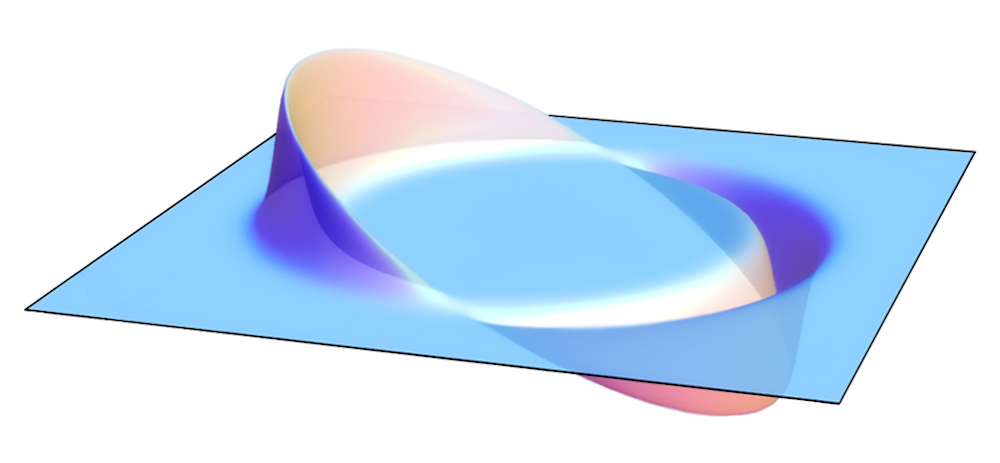
A circle on a flat blue plane with the surface dipping down in front and rising up behind.
This 2-dimensional representation shows the flat, unwarped bubble of spacetime in the center where a warp drive would sit surrounded by compressed spacetime to the right (downward curve) and expanded spacetime to the left (upward curve). AllenMcC/Wikimedia Commons

Compression and expansion

Physicists’ current understanding of spacetime comes from Albert Einstein’s theory of General Relativity. General Relativity states that space and time are fused and that nothing can travel faster than the speed of light. General relativity also describes how mass and energy warp spacetime – hefty objects like stars and black holes curve spacetime around them. This curvature is what you feel as gravity and why many spacefaring heroes worry about “getting stuck in” or “falling into” a gravity well. Early science fiction writers John Campbell and Asimov saw this warping as a way to skirt the speed limit.

What if a starship could compress space in front of it while expanding spacetime behind it? “Star Trek” took this idea and named it the warp drive.

In 1994, Miguel Alcubierre, a Mexican theoretical physicist, showed that compressing spacetime in front of the spaceship while expanding it behind was mathematically possible within the laws of General Relativity. So, what does that mean? Imagine the distance between two points is 10 meters (33 feet). If you are standing at point A and can travel one meter per second, it would take 10 seconds to get to point B. However, let’s say you could somehow compress the space between you and point B so that the interval is now just one meter. Then, moving through spacetime at your maximum speed of one meter per second, you would be able to reach point B in about one second. In theory, this approach does not contradict the laws of relativity since you are not moving faster than light in the space around you. Alcubierre showed that the warp drive from “Star Trek” was in fact theoretically possible.

Proxima Centauri here we come, right? Unfortunately, Alcubierre’s method of compressing spacetime had one problem: it requires negative energy or negative mass.

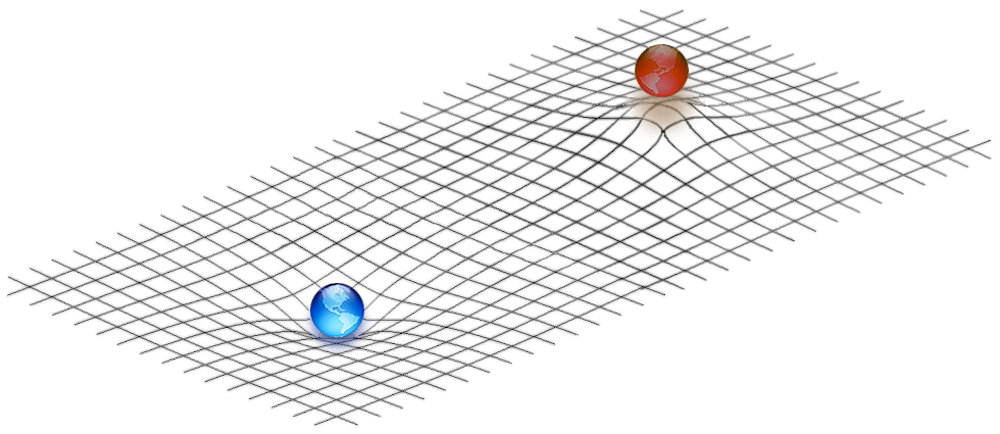
A 2–dimensional diagram showing how matter warps spacetime
This 2–dimensional representation shows how positive mass curves spacetime (left side, blue earth) and negative mass curves spacetime in an opposite direction (right side, red earth). Tokamac/Wikimedia Commons, CC BY-SA

A negative energy problem

Alcubierre’s warp drive would work by creating a bubble of flat spacetime around the spaceship and curving spacetime around that bubble to reduce distances. The warp drive would require either negative mass – a theorized type of matter – or a ring of negative energy density to work. Physicists have never observed negative mass, so that leaves negative energy as the only option.

To create negative energy, a warp drive would use a huge amount of mass to create an imbalance between particles and antiparticles. For example, if an electron and an antielectron appear near the warp drive, one of the particles would get trapped by the mass and this results in an imbalance. This imbalance results in negative energy density. Alcubierre’s warp drive would use this negative energy to create the spacetime bubble.

But for a warp drive to generate enough negative energy, you would need a lot of matter. Alcubierre estimated that a warp drive with a 100-meter bubble would require the mass of the entire visible universe.

In 1999, physicist Chris Van Den Broeck showed that expanding the volume inside the bubble but keeping the surface area constant would reduce the energy requirements significantly, to just about the mass of the sun. A significant improvement, but still far beyond all practical possibilities.

A sci-fi future?

Two recent papers – one by Alexey Bobrick and Gianni Martire and another by Erik Lentz – provide solutions that seem to bring warp drives closer to reality.

Bobrick and Martire realized that by modifying spacetime within the bubble in a certain way, they could remove the need to use negative energy. This solution, though, does not produce a warp drive that can go faster than light.

[Over 100,000 readers rely on The Conversation’s newsletter to understand the world. Sign up today.]

Independently, Lentz also proposed a solution that does not require negative energy. He used a different geometric approach to solve the equations of General Relativity, and by doing so, he found that a warp drive wouldn’t need to use negative energy. Lentz’s solution would allow the bubble to travel faster than the speed of light.

It is essential to point out that these exciting developments are mathematical models. As a physicist, I won’t fully trust models until we have experimental proof. Yet, the science of warp drives is coming into view. As a science fiction fan, I welcome all this innovative thinking. In the words of Captain Picard, things are only impossible until they are not.The Conversation

Mario Borunda, Associate Professor of Physics, Oklahoma State University

This article is republished from The Conversation under a Creative Commons license. Read the original article.